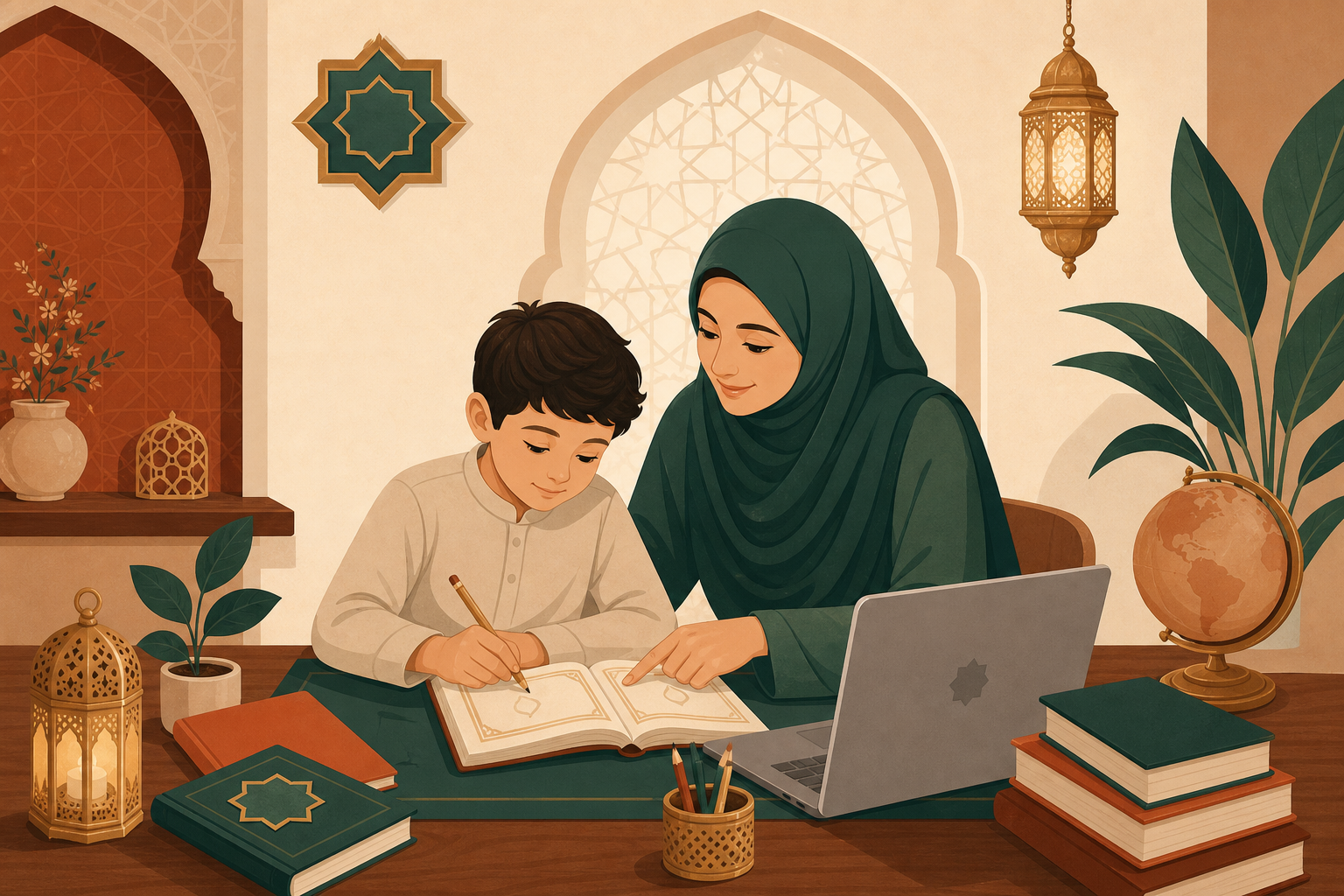
How to Homeschool Arabic in 2026: A Complete Parent's Guide
Everything homeschooling parents need to start teaching Arabic in 2026-27. Covers scheduling, age-appropriate goals, free curriculum, and tips for non-Arabic-speaking families.
Table of Contents
You've made the decision: Arabic is going to be part of your homeschool this year. Maybe your family has cultural or religious ties to the language. Maybe you want to give your children a head start in one of the world's most widely spoken tongues. Or maybe you simply believe — as more and more parents do — that learning Arabic opens doors that few other languages can.
Whatever your reason, you're in the right place. This guide is written specifically for homeschooling parents heading into the 2026–27 academic year. We'll cover how much time to dedicate each week, what realistic progress looks like at different ages, how to use a structured free curriculum alongside worksheets and games, and — most importantly — how to teach Arabic confidently even if you don't speak a single word of it yourself.
Let's get started.
Why Homeschooling Arabic Is More Achievable Than Ever
For years, parents who wanted to include Arabic in their homeschool faced a real problem: quality, affordable, structured materials were hard to find. Most resources were either designed for native-speaker classrooms, too expensive, or scattered across the internet with no coherent sequence.
That has changed dramatically. In 2026, homeschooling parents have access to:
- Free, sequenced curricula covering multiple years of instruction
- Printable worksheets for handwriting, vocabulary, and grammar practice
- Interactive games that make repetition engaging for kids
- Audio and video resources that handle pronunciation so non-speaking parents don't have to
- Supportive online communities of homeschooling families doing exactly what you're doing
The barriers are lower than ever. The question is no longer can you homeschool Arabic — it's how do you do it well.
Understanding What You're Teaching: A Quick Orientation
Before you open a single worksheet, it helps to understand what Arabic actually is — because it's not quite like European languages your children may have encountered.
Arabic is written right to left. This surprises many children (and parents) at first, but kids adapt quickly, often faster than adults.
Letters change shape depending on their position in a word. The same letter looks different at the start, middle, or end of a word, and different again when written alone. This concept — explored in depth in our guide to Arabic letter forms — is one of the first things your child will need to grasp.
There are 28 letters, most of which have sounds that exist in English, though a handful (like the ع and غ) require specific practice. Our complete guide to the Arabic alphabet is an excellent starting point for both parent and child.
Modern Standard Arabic (MSA) vs. Dialects. Most structured homeschool curricula teach MSA — the formal, written form used in education, news, and literature across the Arab world. This is the right choice for homeschoolers. Dialects (Egyptian, Levantine, Gulf, etc.) come later, if at all. See our Arabic dialects overview if you're curious about the differences.
Arabic has a beautiful internal logic. Almost every Arabic word is built from a three-letter root. Once your child learns enough roots, vocabulary acquisition accelerates dramatically. We explain this system fully in our article on the Arabic root system.
Knowing these things upfront will help you set accurate expectations and explain the language's quirks to your children without confusion.
Realistic Expectations by Age
One of the biggest mistakes homeschooling parents make is borrowing expectations from school environments — or from adults learning a second language — and applying them to their children. Children learn differently, and age matters enormously.
Ages 4–6: Oral Foundation First
At this age, formal reading and writing instruction in any language is limited. Focus almost entirely on:
- Listening to Arabic sounds — songs, rhymes, simple stories
- Learning basic greetings like السلام عليكم (As-salamu alaykum) and مرحبا (Marhaba) — see our Arabic greetings guide
- Recognizing the alphabet visually without requiring writing
- Building a small spoken vocabulary: colors, numbers, family members, animals
Realistic weekly outcome after one year: Recognition of most alphabet letters, 30–50 spoken words, and comfortable use of basic greetings.
Ages 7–9: Alphabet + Early Reading
This is the prime window for alphabet instruction. Children this age learn letter shapes surprisingly fast.
- Systematic alphabet teaching, including letter forms (isolated, initial, medial, final)
- Beginning to decode simple words — short vowel sounds (harakat) are your friend here
- Writing practice: Start with isolated letters, then join letters into words
- Vocabulary building: numbers, colors, classroom objects, family
- Very simple sentences: أنا أحمد (Ana Ahmad — I am Ahmad)
Realistic weekly outcome after one year: Reading simple three-letter words with short vowels, writing all 28 letters in isolated form, 80–120 vocabulary words.
Ages 10–12: Structured Language Learning
At this stage, children can handle more formal grammar instruction and start engaging with texts.
- Grammar fundamentals: noun/verb distinction, masculine/feminine, singular/plural — our Arabic grammar basics article covers these well
- Sentence construction: subject-verb-object and verb-subject-object patterns (Arabic allows both)
- Reading short paragraphs with full voweling
- Introduction to the root system
- Writing original short sentences
Realistic weekly outcome after one year: Reading short voweled texts with comprehension, writing 3–5 sentence paragraphs, understanding basic grammatical categories.
Ages 13+: Intermediate Progression
Teens can work with more independence and handle unvoweled text, which is how Arabic is written in the real world.
- Reading unvoweled text (the single biggest jump in Arabic literacy)
- Expanded grammar: verb conjugations, dual forms, broken plurals
- Composition: writing about familiar topics
- Exposure to authentic texts: simple news headlines, Quranic passages, poetry
Realistic weekly outcome after one year: Reading simple unvoweled texts with dictionary support, writing multi-paragraph compositions, functional vocabulary of 400+ words.
How Much Time Per Week?
This is the question every homeschooling parent asks first, and the honest answer is: less than you think, applied consistently.
Here are practical time recommendations by age group:
| Age Group | Daily Time | Weekly Total | Sessions/Week |
|---|---|---|---|
| 4–6 | 10–15 min | 50–75 min | 4–5 |
| 7–9 | 20–25 min | 1.5–2 hrs | 4–5 |
| 10–12 | 30–40 min | 2.5–3 hrs | 4–5 |
| 13+ | 40–50 min | 3–4 hrs | 4–5 |
The golden rule: frequency beats duration. A child who practices Arabic for 20 minutes every weekday will outperform one who does a two-hour session once a week. Spaced repetition — returning to material across multiple days — is how the brain cements new language patterns.
Build in a dedicated handwriting day. Arabic handwriting requires motor skill development separate from vocabulary or grammar work. One session per week dedicated purely to writing practice produces noticeably better results than mixing it into every lesson.
Don't count passive exposure. Listening to Arabic music or watching Arabic cartoons is wonderful supplementary immersion, but it doesn't replace structured lesson time. Count only intentional, focused learning toward your weekly targets.
Using the Free 11-Year Arabic Curriculum
Arabic123.com offers a completely free, structured curriculum covering 11 years of Arabic language development — from absolute beginner to advanced literacy. You can access it at /curriculum.
Here's how to use it effectively in your homeschool:
Start with a Placement Check
If your child is starting from zero, begin at Year 1 regardless of age (though older beginners move through early stages faster). If your child has some prior exposure, spend one week reviewing Year 1 material to confirm readiness before advancing.
Follow the Sequence — Mostly
The curriculum is sequenced so that each skill builds on the previous one. Alphabet before words, words before sentences, sentences before paragraphs. Resist the urge to skip ahead because a topic seems simple. What looks like review is often consolidation of foundations that will matter later.
That said, homeschooling gives you flexibility. If your child is flying through grammar but struggling with handwriting, you can slow down handwriting lessons without holding back everything else.
Week-by-Week Planning
A typical week using the curriculum might look like this:
- Monday: New lesson from curriculum sequence (introduce concept)
- Tuesday: Worksheet practice on Monday's concept (/worksheets)
- Wednesday: Vocabulary review + vocabulary games
- Thursday: Writing practice / handwriting
- Friday: Review game, oral review, or a fun activity connecting to the week's topic
Pacing for Different Ages
- Ages 4–6: One curriculum unit every 2–3 weeks is fine. Don't rush.
- Ages 7–9: One unit per week is a solid pace.
- Ages 10–12: Can handle 1–2 units per week once foundations are solid.
- Ages 13+: Move at the pace the material allows — some units will be review.
Combining Worksheets, Games, and Direct Instruction
The most effective homeschool Arabic lessons aren't lectures. They're a blend of three distinct types of activity, each serving a different cognitive purpose.
Direct Instruction (15–20% of time)
This is you — or a video, or an audio resource — explicitly explaining something. "This letter is called بَاء (Baa). It makes the /b/ sound. Here is what it looks like in four positions." Direct instruction is efficient for introducing new concepts but inefficient for building fluency. Keep it short.
Worksheets (40–50% of time)
Worksheets provide the structured, focused repetition that cements learning. Arabic123's printable worksheets cover:
- Alphabet tracing — essential for young learners developing motor control
- Letter identification — circling, matching, sorting exercises
- Vocabulary labeling — matching Arabic words to images
- Fill-in-the-blank grammar — practicing sentence patterns with scaffolding
- Reading comprehension — short passages with questions
Print a week's worksheets on Monday so they're ready to go. This removes friction from daily lessons.
Games (30–40% of time)
Games provide something worksheets can't: low-anxiety, high-repetition practice. When a child is playing, they'll happily repeat a vocabulary word twenty times without noticing. The Arabic games at Arabic123 include options for:
- Alphabet recognition — letter matching and memory games
- Vocabulary building — flashcard-style challenges with images
- Number practice — connecting Arabic numerals and words (see also our Arabic numbers guide)
- Spelling — arranging letters to form words
Games are also excellent for siblings of different levels — a child reviewing material they know can play alongside a child encountering it fresh, and both benefit.
A Note on Arabic Text in Lessons
Make sure your child sees Arabic script — not just transliteration — from day one. It's tempting to use romanized spellings (like marhaba for مرحبا) as a crutch, but this delays script literacy. Use transliteration as a pronunciation aid only, and always display the Arabic script alongside it.
Tips for Non-Arabic-Speaking Parents
Perhaps the most common worry among homeschooling parents is this: "How can I teach Arabic when I don't speak it?"
You can. Here's how.
Lean on Audio Resources
You don't need to model perfect pronunciation — you need to provide your child with access to it. Use:
- The audio pronunciations built into Arabic123's alphabet pages and vocabulary sections
- YouTube channels specifically designed for Arabic learners
- Arabic children's songs and rhymes (search "Arabic nasheed for kids" for a wealth of options)
Make it a habit: when a new word is introduced, your child hears it from an audio source before trying to say it themselves.
Learn Alongside Your Child
You don't need to be a step ahead. Many non-Arabic-speaking parents have successfully homeschooled the language by being honest with their children: "We're both learning this together." This is not a weakness — it's a powerful model. Your child watches you struggle with a new script and persist anyway. That's a lesson more valuable than any grammar rule.
Start by working through our complete Arabic alphabet guide yourself. Add the 100 most common Arabic words to your own vocabulary. You'll be surprised how quickly a functional foundation develops.
Use Structured Curriculum as Your Teacher
A well-designed curriculum does the pedagogical thinking for you. It decides what to teach when, how to sequence skills, and what practice looks like. Your job as a non-speaking parent isn't to invent lessons — it's to facilitate them. Pull up the day's lesson, sit with your child, and work through it together.
Connect with a Tutor for Targeted Pronunciation Help
If pronunciation is a serious concern, consider scheduling a monthly or fortnightly video session with an Arabic tutor — not for full instruction, but specifically for pronunciation feedback. Platforms like iTalki and Preply have tutors who work well with children. Even 30 minutes a month with a native speaker can significantly improve your child's oral Arabic.
Build a Phrase Bank Together
Create a shared family reference of Arabic phrases you use together. Greetings when waking up (صباح الخير — Sabah al-khayr, good morning), before meals (بسم الله — Bismillah), and at bedtime. These become natural, daily touchpoints that extend Arabic beyond lesson time — and they're easy for a non-speaking parent to adopt.
Tracking Progress Without Formal Assessment
One of the freedoms — and challenges — of homeschooling is that you don't have standardized tests to tell you how your child is doing. Here's how to track Arabic progress meaningfully.
The Observation Portfolio
Keep a simple folder (physical or digital) with dated samples of your child's work:
- A worksheet from Week 1, Week 10, Week 20 — the visual improvement in handwriting alone is striking
- Voice recordings of your child reading aloud, taken monthly
- A photo of a spontaneous moment: your child writing their name in Arabic, or reading a word on a package
Review the portfolio each term. Progress is often invisible week-to-week but obvious over months.
Skill Checklists
Use simple checklists tied to the curriculum's scope and sequence:
Alphabet Level:
- Identifies all 28 letters in isolated form
- Reads letters in initial, medial, and final positions
- Writes all letters from memory
- Connects letters to form simple words
Reading Level:
- Reads short voweled words (CVC pattern)
- Reads short voweled sentences
- Reads short paragraphs with full voweling
- Reads simple unvoweled text
Vocabulary Level:
- 50 words with recognition
- 100 words with recognition
- 50 words can be used in a sentence
Tick items off as your child demonstrates mastery on multiple occasions — not just once.
Informal Oral Checks
Every Friday, spend five minutes in a low-stakes "what do you know?" conversation. Ask your child to:
- Tell you what a flashcard says
- Read three lines from a familiar text
- Explain what a word means
- Write a word or short phrase from dictation
This isn't a test — it's a conversation. But it gives you real-time data on retention.
Celebrate Milestones Visibly
When your child finishes the alphabet, celebrate it. When they read their first full sentence, make it a moment. A sticker chart for young learners, a certificate for older ones, a special meal — whatever fits your family culture. External milestones matter more in homeschool, where the natural structure of terms and grade progressions doesn't exist.
Building Cultural Context Alongside Language
Language lives inside culture. Children who learn Arabic with some connection to its cultural context retain it better and find it more meaningful.
You don't need to become an expert in Arab culture to do this. Simple touchpoints work well:
- Names: Exploring the meaning behind names is a surprisingly effective vocabulary and cultural activity. Our Arabic names directory and articles on Arabic boy names and Arabic girl names are rich resources here.
- Geography: Locate Arabic-speaking countries on a map. Discuss that Arabic sounds slightly different in Egypt, Lebanon, and Saudi Arabia — a concept introduced beautifully in our dialects overview.
- Food: Cook a simple Arabic dish and name the ingredients in Arabic. A bowl of hummus with خبز (khubz, bread) and زيت زيتون (zayt zaytun, olive oil) is both a snack and a lesson.
- Calligraphy: Arabic calligraphy is one of the great art forms of the world. Have your child try simple calligraphic lettering — it improves handwriting and builds appreciation for the script's aesthetics.
For families with religious motivations for learning Arabic, connecting language learning to Quranic engagement adds immediate meaning. Even very young children can learn to recognize words they hear in prayer.
Common Mistakes to Avoid
Learn from the experience of homeschooling parents who've come before you:
Skipping the alphabet to "get to the real stuff." There is no shortcut here. The alphabet is the real stuff. Every hour invested in solid alphabet mastery pays dividends for years.
Overwhelming with too much at once. Introducing three new letters, ten new vocabulary words, and a grammar concept in one week is a recipe for frustration. One thing at a time, done thoroughly.
Relying only on one type of resource. Worksheets without games create boredom. Games without structured practice create gaps. Curriculum without real-world connection creates disengagement. Balance all three.
Stopping and restarting. A six-week gap in Arabic instruction at age 8 can wipe out months of vocabulary retention. If life gets busy, keep a minimum viable practice going — even 10 minutes of flashcards three times a week is enough to maintain without adding new material.
Comparing to classroom peers. A child in a school Arabic class may appear to be progressing faster because they have daily exposure with peers. But homeschooled children often develop deeper, more durable literacy because of the one-on-one attention and flexible pacing. Trust your process.
Your First Month: A Practical Starter Plan
Here's a concrete plan for your first four weeks:
Week 1: Orientation
- Parent reads this guide fully and explores the curriculum
- Child is introduced to Arabic: what it looks like, where it's spoken, why we're learning it
- Begin with the first five letters: أ ب ت ث ج
- Use the alphabet page for audio reference
- Print alphabet tracing worksheets for those five letters
Week 2: Letters 6–12
- Continue alphabet sequence: ح خ د ذ ر ز س
- Review Week 1 letters daily (5 minutes)
- Introduce first game: alphabet letter matching
- Begin family Arabic phrase bank (3 phrases)
Week 3: Letters 13–20
- ش ص ض ط ظ ع غ ف
- Note: ع and غ are challenging. Extra audio practice here.
- Review all previous letters with flashcard game
- Expand phrase bank to 6 phrases
Week 4: Letters 21–28 + First Review
- ق ك ل م ن ه و ي
- Full alphabet review week: games, worksheets, oral identification
- First portfolio entry: child writes their name in Arabic
- Celebrate completing the alphabet!
By the end of Month 1, your child knows all 28 Arabic letters in isolated form. That's a genuine, measurable achievement — and it's the foundation everything else is built on.
Final Thoughts: You're More Ready Than You Think
Homeschooling Arabic is a meaningful undertaking. It requires consistency, patience, and a willingness to sit with a script that looks nothing like English. But it is absolutely within your reach — whether you speak Arabic fluently, haltingly, or not at all.
The resources available to you in 2026 make this more achievable than ever before. A free 11-year curriculum, printable worksheets, engaging games, and a rich library of guides (like those you'll find throughout this site) mean that the materials are not the barrier.
The only ingredient that can't be provided for you is consistency. Show up four or five times a week for those 15–40 minutes. Celebrate small wins. Trust the sequence. And watch, over the course of a year, as your child moves from staring blankly at foreign-looking squiggles to reading their first Arabic sentence.
That moment is worth every worksheet.
Ready to begin? Start with the full Arabic curriculum, explore our Arabic alphabet resources, and bookmark this guide for reference throughout your year. Your 2026–27 Arabic homeschool starts now.
Tags
Continue Learning
- learning Arabic opens doors
- Arabic letter forms
- complete guide to the Arabic alphabet
- Arabic dialects overview
- Arabic root system
- Arabic greetings guide
- Arabic numbers guide
- Arabic grammar basics
- curriculum
- worksheets
- Arabic games
- alphabet pages
- vocabulary sections
- 100 most common Arabic words
- Arabic names directory
- Arabic boy names
- Arabic girl names
- dialects overview
- how to write Arabic
- Arabic sentence structure