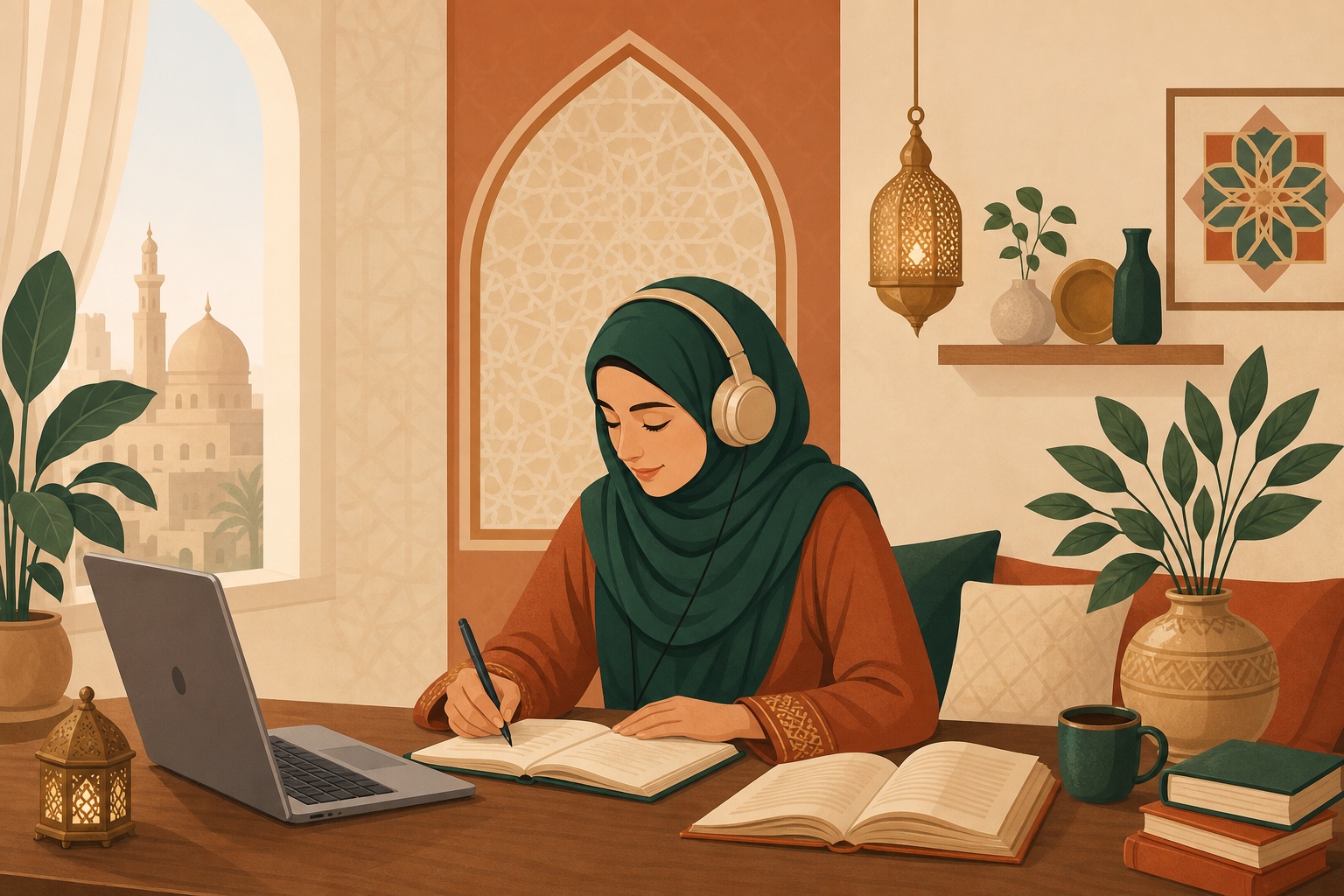
Arabic Immersion at Home: Tips for Practicing Without Travel
You don't need a plane ticket to immerse yourself in Arabic. Discover powerful strategies to create a full Arabic immersion environment right at home.
Table of Contents
Many language learners believe that true fluency only comes from living abroad — spending months in Cairo, Amman, or Dubai, surrounded by native speakers 24/7. While travel is undeniably valuable, it is far from the only path to Arabic immersion. With the right strategies, you can recreate an immersive Arabic environment in your own home, on your own schedule, and at a fraction of the cost.
This guide will show you exactly how to do that — from transforming your physical space to rewiring your daily digital habits. Whether you are a complete beginner or an intermediate learner looking to push through a plateau, these Arabic immersion tips will help you make faster, more consistent progress.
Why Immersion Works — Even at Home
Immersion is effective because it forces your brain to process a language in context rather than in isolated drills. Instead of memorising a vocabulary list and then forgetting it by morning, immersion ties words and phrases to real experiences, emotions, and routines.
Research in second-language acquisition consistently shows that comprehensible input — hearing and reading Arabic that you can mostly understand — is one of the most efficient routes to fluency. The key word is mostly. A little bit of challenge keeps your brain engaged without overwhelming it.
The good news? Comprehensible input is everywhere online. Arabic podcasts, YouTube channels, streaming services, social media, and language exchange apps give you access to more native Arabic content today than a learner living in an Arab country could have found just twenty years ago.
Before you dive into the tips below, make sure you have a solid foundation in place. If you are still getting comfortable with the script, check out our Complete Guide to the Arabic Alphabet for Beginners and our article on Arabic Letter Forms: Isolated, Initial, Medial, and Final to build reading confidence first.
Tip 1: Label Your Home in Arabic
One of the simplest and most underrated Arabic immersion tips is to physically label the objects around you. Grab a pack of sticky notes and start writing Arabic words for everything in your house.
| Object | Arabic | Transliteration |
|---|---|---|
| Door | باب | Bāb |
| Window | نافذة | Nāfidha |
| Kitchen | مطبخ | Maṭbakh |
| Bed | سرير | Sarīr |
| Book | كتاب | Kitāb |
Every time you open the refrigerator (الثلاجة — al-thallāja) or sit on the sofa (الأريكة — al-arīka), your brain registers the Arabic word. Over days and weeks, these associations become automatic.
To build your vocabulary beyond household objects, explore our curated Arabic vocabulary categories for organised word lists across dozens of topics.
Tip 2: Change Your Device Language to Arabic
This one feels scary to most learners, but it is remarkably effective. Switching your phone, tablet, or computer interface to Arabic forces you to engage with the script multiple times every single hour. You already know where the Settings app is — you do not need to read every word to navigate. That low-stakes repetition is exactly what builds reading fluency.
Start with your phone. Go to Settings → General → Language and select Arabic (العربية). The most common interface words you will encounter immediately:
- إعدادات — Settings
- بحث — Search
- الرسائل — Messages
- الكاميرا — Camera
- موافق — OK / Confirm
If switching everything feels too overwhelming, try changing just one app first — your calendar or your notes app. Gradual exposure is still powerful exposure.
Tip 3: Consume Arabic Media Every Day
This is the engine of your home Arabic immersion programme. Consistent daily exposure to authentic Arabic — even for 20–30 minutes — compounds dramatically over time.
Arabic TV and Film
Netflix, YouTube, and MBC offer extensive libraries of Arabic content. Start with shows that include Arabic subtitles so you can connect spoken words to written text. Some popular starting points:
- Paranormal (بارانورمال) — Netflix Egyptian thriller, great for hearing Modern Egyptian Arabic
- Jinn (جن) — Netflix Jordanian supernatural drama, Levantine dialect
- MBC Masr — Free Egyptian Arabic television online
For guidance on which variety of Arabic suits your goals, read our breakdown of Arabic Dialects: MSA, Egyptian, Levantine, Gulf, and More.
Arabic Podcasts and Radio
- Sawa Radio — Slow, clear Modern Standard Arabic (MSA) news broadcasts
- ArabicPod101 — Graded lessons for all levels
- BBC Arabic — Authentic news programming for intermediate and advanced learners
Arabic Music
Music is one of the most enjoyable forms of Arabic immersion. Artists like Fairuz (فيروز), Amr Diab (عمرو دياب), and Mohamed Mounir (محمد منير) have rich lyrical vocabularies. Look up lyrics, read along, and pay attention to how words are stressed and connected in natural speech.
Tip 4: Think and Journal in Arabic
One of the hardest transitions in language learning is moving from translating in your head to thinking directly in Arabic. You can accelerate this shift by making Arabic part of your internal monologue.
Start small. When you wake up, think: صباح الخير (Ṣabāḥ al-khayr — Good morning). When you make coffee, try to name each action in Arabic. When you feel an emotion, reach for the Arabic word.
Keeping a short Arabic journal is equally powerful. Even three sentences a day builds writing fluency and forces you to retrieve vocabulary actively. You do not need perfect grammar — progress matters more than perfection.
For vocabulary to get started, visit our list of 100 Most Common Arabic Words Every Beginner Should Know and our guide to Arabic Greetings and Phrases.
Tip 5: Use Language Exchange and Online Tutors
No immersion environment is complete without real human interaction. Fortunately, connecting with native Arabic speakers has never been easier.
Language exchange apps and platforms:
- HelloTalk — Text, voice, and video chat with native speakers who want to learn English
- Tandem — Similar to HelloTalk with a cleaner interface
- iTalki — Hire a professional Arabic tutor or a community language partner for affordable one-on-one sessions
- Preply — Another excellent tutoring marketplace
Even one 30-minute conversation per week with a native speaker will sharpen your listening comprehension and pronunciation far faster than self-study alone. Come prepared with a topic, a list of new vocabulary you have learned, or questions about phrases you encountered in media that week.
Tip 6: Structure Your Day Around Arabic
Random Arabic practice sessions are less effective than building the language into your daily routine. Here is a sample Arabic immersion schedule you can adapt:
| Time | Activity | Duration |
|---|---|---|
| Morning | Review flashcards (Anki/Quizlet) | 10 min |
| Commute/Lunch | Arabic podcast or music | 20–30 min |
| Afternoon | Read Arabic text (news, social media) | 10–15 min |
| Evening | Watch Arabic TV with subtitles | 30–45 min |
| Before bed | Journal 3–5 sentences in Arabic | 10 min |
This adds up to roughly 1.5 hours of Arabic exposure per day — without any single block feeling overwhelming. Consistency beats intensity every time.
Tip 7: Immerse Yourself in Arabic Text
Reading is one of the most scalable ways to build vocabulary and grammar intuition simultaneously. Here are several ways to flood your day with Arabic text:
- Follow Arabic social media accounts — News pages, meme accounts, and Arabic celebrities post constantly. Even skimming your feed exposes you to natural written Arabic.
- Read Arabic news — Al Jazeera (الجزيرة), BBC Arabic, and Sputnik Arabic all offer articles in MSA. Start with headlines before attempting full articles.
- Use bilingual books — Find Arabic-English parallel texts on topics that genuinely interest you.
- Read children's books in Arabic — The vocabulary is controlled and the sentences are short — perfect for building reading momentum.
As your reading improves, you will start to notice the beautiful patterns of the Arabic root system. Our article on the Arabic Root System: How 3-Letter Roots Build Words will make these patterns click.
Tip 8: Build an Arabic-Friendly Physical Space
Your environment shapes your habits. Beyond sticky note labels, consider these additions to your Arabic immersion setup:
- Hang an Arabic alphabet chart on your wall — Seeing the letters daily reinforces recognition. Explore our Arabic alphabet reference for a clean, printable overview.
- Keep an Arabic-English dictionary on your desk — The habit of physically looking up words reinforces memory better than tapping a translation app.
- Display Arabic calligraphy — Beautiful script keeps Arabic present and positive in your space. Search for Quranic verses or Arabic proverbs as wall art.
- Use Arabic number labels — Label your shelves, steps, or even your weekly planner in Arabic numerals. Our Arabic numbers guide covers pronunciation from 1 to 100.
Tip 9: Leverage Spaced Repetition for Vocabulary
No immersion strategy works without vocabulary. Spaced repetition software (SRS) like Anki is scientifically proven to maximise long-term retention by showing you words at precisely the moment you are about to forget them.
Create Anki decks around the vocabulary you encounter in your media consumption. When you hear a new word in a podcast or see it on a TV show, add it to your deck with an example sentence. This keeps your vocabulary study connected to real-world Arabic rather than abstract word lists.
You can also explore our dedicated Arabic vocabulary section for thematic word groups — food, family, travel, business — to build vocabulary around areas that matter most to you.
Tip 10: Set Milestones and Celebrate Progress
Immersion without direction can feel overwhelming. Break your Arabic journey into concrete, measurable milestones:
- Week 1–2: Learn the full Arabic alphabet and basic letter forms ✓
- Month 1: Recognise and use the 100 most common Arabic words ✓
- Month 2: Hold a 5-minute conversation with a language partner ✓
- Month 3: Watch an entire Arabic episode without English subtitles ✓
- Month 6: Read a short Arabic news article with less than 10 unknown words ✓
Tracking progress makes the invisible visible. Celebrate every milestone — language learning is a long game, and motivation is a resource you need to actively protect.
Putting It All Together
Arabic immersion at home is not about doing everything at once. It is about consistently stacking small exposures until Arabic becomes woven into the fabric of your daily life. Change your phone language. Label your kitchen. Watch an Egyptian drama tonight. Write three sentences before bed.
Each of these actions, taken alone, feels modest. Together, they create the same neural pressure that living abroad does — without the plane ticket.
If you are just getting started and want a clear roadmap, read our guide on How to Learn Arabic Fast: 10 Proven Strategies. And if you want to understand the deeper reasons why Arabic is worth this investment of time and energy, our article on The Importance of Arabic: Why Learn Arabic in 2025? will inspire you.
Arabic is one of the world's great languages — rich in history, alive in culture, and spoken by over 400 million people. Your immersion journey starts at home. It starts today.
يمكنك التحدث بالعربية — You can speak Arabic.
Tags
Continue Learning
- Complete Guide to the Arabic Alphabet for Beginners
- Arabic Letter Forms: Isolated, Initial, Medial, and Final
- Arabic vocabulary categories
- Arabic Dialects: MSA, Egyptian, Levantine, Gulf, and More
- 100 Most Common Arabic Words Every Beginner Should Know
- Arabic Greetings and Phrases
- Arabic Root System: How 3-Letter Roots Build Words
- Arabic alphabet reference
- Arabic numbers guide
- Arabic vocabulary section
- the 100 most common Arabic words
- How to Learn Arabic Fast: 10 Proven Strategies
- The Importance of Arabic: Why Learn Arabic in 2025?